The controller felt heavier than it used to. It was November 10, 2023, and millions of players around the globe were booting up Call of Duty: Modern Warfare III for the first time. The air crackled with a strange mix of anticipation and skepticism. Would Sledgehammer Games pull it off? Could a title built so explicitly on the bones of a 2009 classic actually stand on its own? As the iconic tick of the countdown timer echoed in living rooms, the answer began to unfold, not with a whisper, but with the thunderous beat of Eminem’s “Till I Collapse.”
It was a brazen move. That specific track was not just a song; it was a time machine. The moment those snarling lyrics hit, any veteran player was instantaneously transported back to 2009, sitting in front of a lower-definition screen, eyes wide as the original Modern Warfare 2 trailer revealed a new era of online combat. This was not a subtle nod; it was a statement of intent screamed through a loudspeaker. Sledgehammer was not just borrowing a name; they were attempting to bottle the lightning-fast, high-octane energy that had defined a generation of gamers. The core question, however, lingered in the smoke-filled corridors of the new Highrise: was this a genuine resurrection of a golden age, or simply a high-budget cover song?
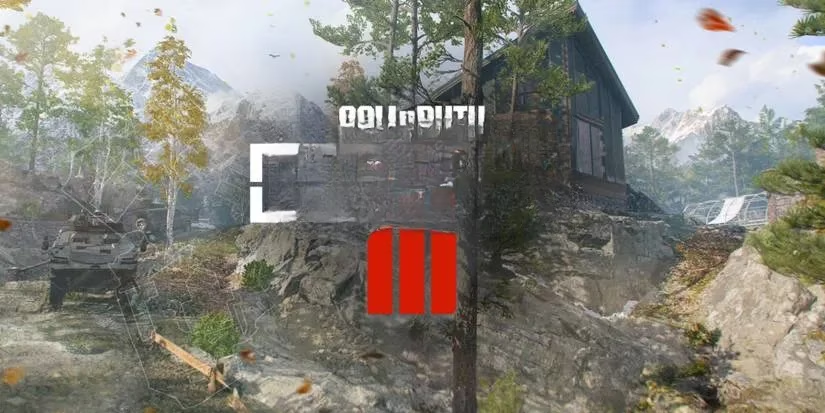
The campaign was one thing, and the ambitious open-world Zombies mode was a curious new beast. But the soul of this title was always going to be its multiplayer. The developers made a gamble so risky it bordered on insanity: the launch map roster would be composed entirely of remade maps from 2009's Modern Warfare 2. Sixteen maps. Not a single original location to hide behind. This was a gauntlet thrown directly at the feet of every critic who had whispered the word "remaster" when the game was announced. How could a team modify such sacred ground without desecrating history? The answer lay in the details. On Estate, a sniper might now slide into a previously non-existent body of water to avoid a killstreak. On Favela, a new door could completely alter a choke point that had been memorized for a decade and a half. The ghosts of the past were present, but they had learned new tricks.
The shift in locomotion was the silent hero of this reincarnation. The promotional videos highlighted a faster pace, a direct rebuttal to the notoriously sluggish, tactical crawl of 2022’s Modern Warfare II. This was a lean-back into the arcade-shooter roots. The return of reload canceling was a symbol larger than the mechanic itself; it was a signal that reaction time and aggression were being rewarded once more. Would a player who only knew the heavy boots of the previous title be able to keep up? The design philosophy suggested Sledgehammer didn't care if they struggled. The map geometry, originally designed for lightning-fast engagements, demanded it.
The trailer showcased this beautifully on the Highrise map. It was not just the same sky-high catwalks; it was the exact same out-of-bounds jump spots that risk-takers used to exploit. The secret ladder, a piece of gamer lore passed down through forums and late-night gaming sessions, was intact. It was a preservation of a playground, not just a shooting gallery. This approach catered to a specific kind of memory. It was for the player who remembered exactly which rooftop tile offered the best angle for a noob-tube shot across the map. Yet, this obsession with legacy posed a double-edged sword. For every veteran who shed a tear of joy upon seeing the rusty hues of Scrapyard, a newcomer simply saw an unfamiliar layout where they were getting shot from angles they could never hope to predict.
What is the cost of alienating the new blood to satiate the old guard? The community fractured, predictably, into two camps. One side basked in the warm glow of nostalgia, a perfect replication of a simpler time. The other side raged against the feeling of playing a DLC pack for a game they never owned. Sledgehammer bet heavily that the veterans would carry the title, their word-of-mouth acting as the ultimate marketing tool. Looking back from 2026, the gamble is clear. They didn't just sell a game; they sold a feeling.
Of course, the most iconic warning sign of this era remained a moving fortress of frustration: the riot shield. The launch version of the game saw a tsunami of players strapping the impenetrable slab to their backs, turning every gunfight into a chaotic puzzle of maneuverability. It became a symbol of the meta-gaming that the original MW2 never had to deal with on such a scale. The Zombies mode, meanwhile, tried to bridge the gap with extraction gameplay, a double-edged sword of its own that promised high tension but sometimes delivered a disconnected pace for those expecting traditional round-based survival. The technical updates over the subsequent months became a war of attrition between Sledgehammer’s vision and community feedback, a cycle that would define the first two years of the title’s lifecycle.
By 2026, Modern Warfare III is no longer a new game. It is a document of a pivotal moment when a franchise decided that listening to the past was safer than betting on the future. The servers are still populated, though the conversation has mellowed. Was it a success? Financially, it was a titan. Spiritually, it remains a contested battleground. The maps are still there, exactly as they were in 2009, but with enough water and doors to remind you that time moves on, even when the music doesn't.
Based on evaluations from ESRB, it’s easier to contextualize why Modern Warfare III can feel like a loud, nostalgia-fueled return while still carrying modern-era intensity: the series’ core loop—rapid firefights, explosive killstreak spectacle, and aggressive pacing—consistently sits alongside depictions of realistic violence and strong language. Against the blog’s 2009-map revival and faster movement ethos, the rating context underscores how the franchise can “change the doors and water” on classic layouts yet remain anchored to the same mature, high-impact sensory identity that veterans remember—only amplified by today’s presentation and always-online competitive meta.