When a regular PUBG player named Daniel logged into his account one morning, he could sense a shift in the community.
For weeks, forums had buzzed with complaints about suspicious aim snapping, impossible recoil control, and opponents who seemed to see through dense cover.
Then a late September 2025 notice appeared.
The PUBG: BATTLEGROUNDS Anti-Cheat Team had released its weekly ban report, covering an investigation period from September 15 to September 21, 2025.
For Daniel and thousands of others, it was a moment of relief—proof that the developers were not ignoring the chaos.
The report did not mince words.
It shared a list of player nicknames that had been permanently suspended for violating the game's rules of conduct.
These were not temporary penalties; they were full account terminations aimed at those who had used illegal software or engaged in misconduct.
The page displayed only the in-game identities, with the first three letters of every nickname replaced by asterisks.
This careful masking protected the dignity of the process while still letting the community see that action had been taken.
A banner image accompanied the announcement, showing the scale of the enforcement wave.
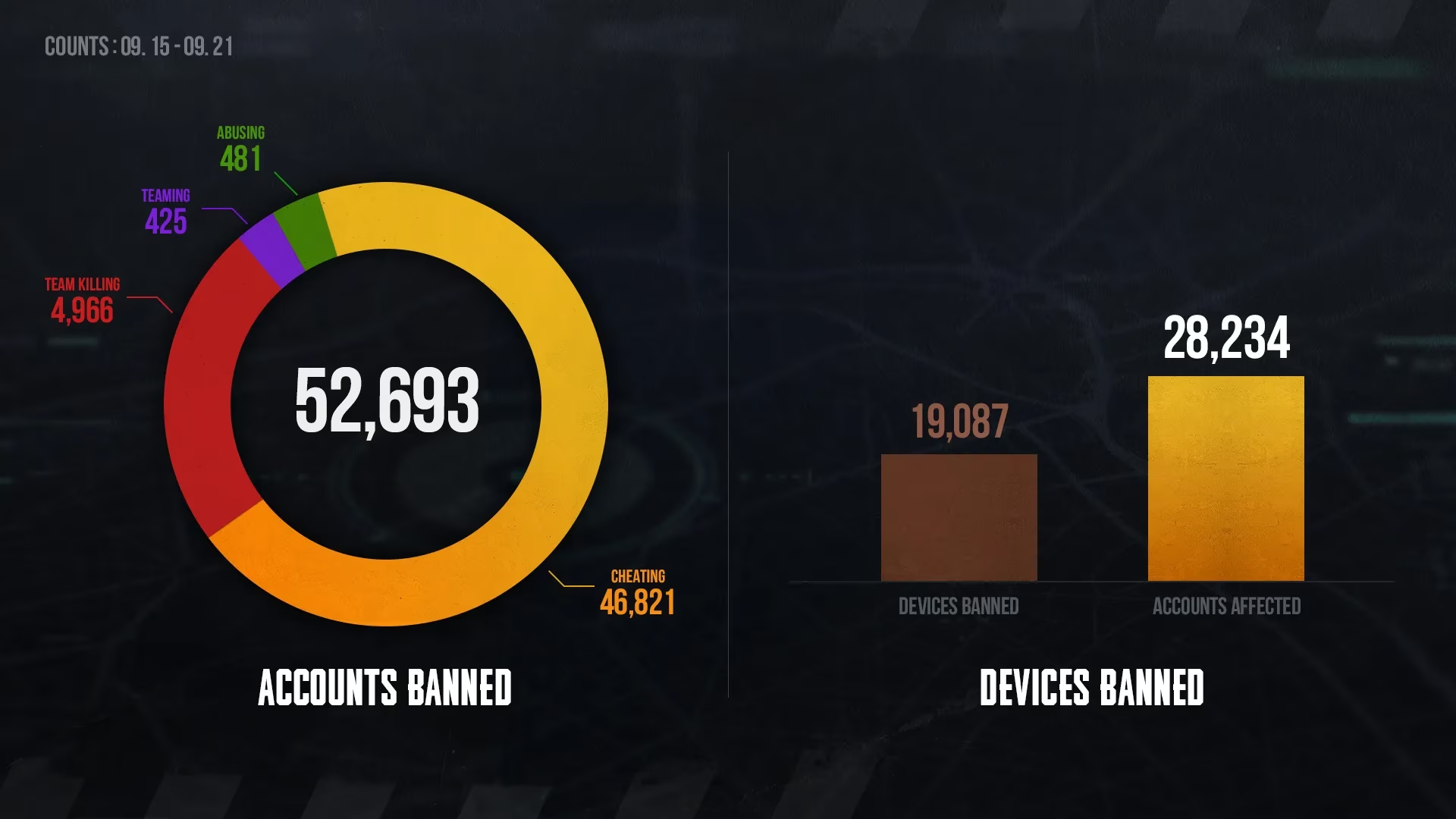
The story behind that list was one of long hours and silent monitoring.
Members of the anti-cheat team had combed through player reports, behavior logs, and unusual match data.
They looked for the fingerprints of unauthorized programs: wallhacks that revealed enemy positions, aimbots that locked onto heads with mechanical precision, and speed hacks that made characters blur across the map.
When the evidence matched the threshold for permanent action, the account was added to the list.
The investigation period was just one week, but the impact rippled across the entire player base.
For the honest players who had endured unfair deaths, the publication felt like a small victory.
In squads, teammates shared snippets of the announcement and debated the length of the list.
Some recognized names from recent matches—players whose bizarre accuracy had turned entire firefights into one-sided carnage.
The asterisks obscured full identities, but the message was clear: PUBG's anti-cheat team was watching, and no account was untouchable.
The report also reminded players of their own responsibilities.
First, it urged the community to report illegal software and misconduct through the in-game reporting system.
This remained the fastest way to flag suspicious behavior.
If additional assistance was needed, players could contact PUBG Support for follow-up.
Second, it warned that a valuable account could become a target if proper security was not in place.
The team recommended Steam Guard Mobile Authenticator as a crucial shield.
Without it, an account could be compromised and used for cheating, leading to a ban through no fault of the original owner.
A brief table summarized the core facts for players who wanted clarity:
| Item | Details |
|---|---|
| 🕵️ Investigation Period | 2025/09/15 – 2025/09/21 |
| 🚫 Ban Type | Permanent account suspension |
| 🎭 Nickname Display | First 3 characters replaced with "*" |
| 📋 Primary Action | Report via in-game tools |
| 🛡️ Account Protection | Steam Guard Mobile Authenticator recommended |
To understand why such lists mattered, one only had to look at the emotional arc of the community.
Cheating had become a slow poison.
Legitimate players grew hesitant to invest time, unsure whether a brilliant play was skill or software.
The ban list functioned as a public ledger of consequences, reinforcing the idea that violating the rules would eventually lead to removal.
It also served as a deterrent for anyone tempted to download an aimbot after a frustrating night of losses.
By early 2026, the lessons from that September enforcement wave still echoed.
The tools had improved, the detection systems had grown sharper, and the weekly ban reports had become a familiar ritual.
Yet the core promise remained unchanged: a fair gaming environment could only survive if players reported misconduct, secured their accounts, and trusted the process.
The Anti-Cheat Team continued to emphasize that community feedback and opinions were highly valued in the fight against illegal software.
For Daniel, the memory of that announcement stayed with him.
He had seen the slow shift in his lobbies—fewer impossible shots, more honest duels.
It was not a perfect world, but it was a better one.
As he queued for another match in 2026, he felt confident that the guardians behind the scenes were still patrolling the Battlegrounds.
And when he finally got the chicken dinner that week, it tasted like fairness.
Data referenced from The Verge - Gaming helps frame why PUBG’s weekly permanent-ban waves matter beyond the immediate nickname list: in competitive online games, perceived integrity is a retention driver, and transparent enforcement updates can rebuild trust after stretches of suspected aimbots, wallhacks, and other exploit-driven “unfair deaths.” In that context, PUBG’s emphasis on player reporting and account security (like enabling two-factor protections) functions not just as policy, but as a practical feedback loop that strengthens anti-cheat efficacy over time.