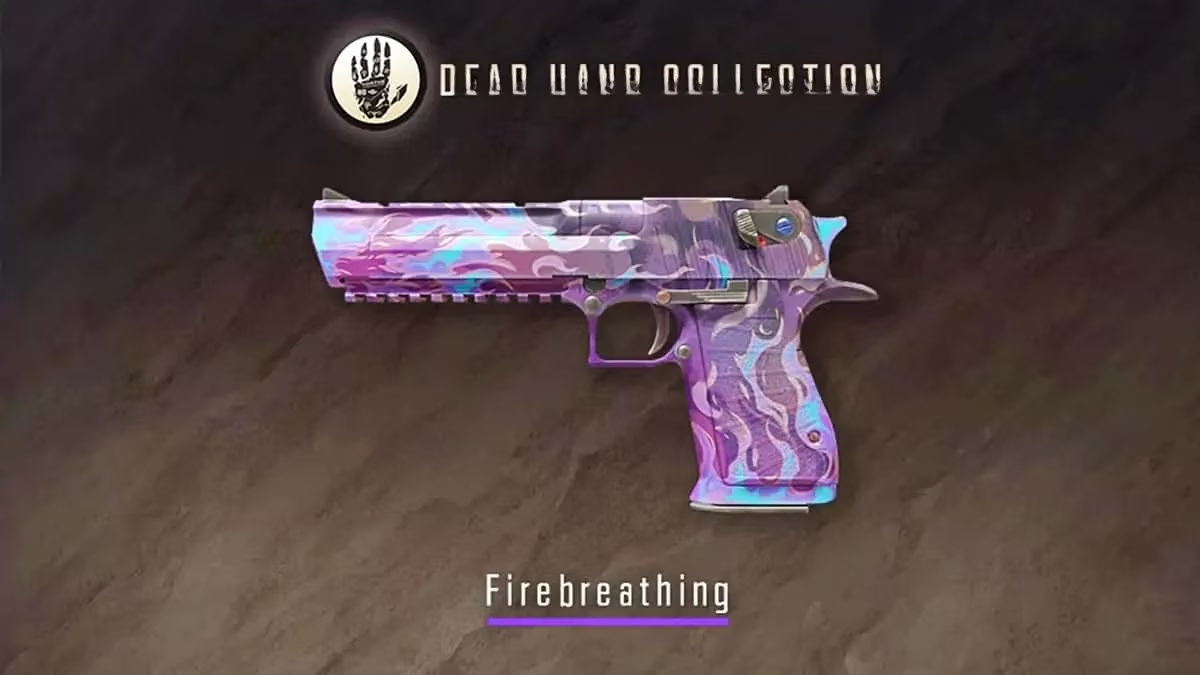
I was scrolling through my CS2 inventory the other night, mindlessly swapping skins like I always do when I can't sleep, and my Desert Eagle | Dead Hand caught the glow of the monitor. This skin—a scarred, industrial beast of a hand-cannon—suddenly felt heavier. You know that weird moment when an in-game item stops being just a texture and becomes a story? That happened. Because I'd just read that its creator, a guy named React, got a flat $35k from Valve. And the internet, as it does, was absolutely losing its mind.
I'd been following the Dead Hand Collection since it dropped. The skins are meticulous, grim, and oddly soulful in a way most factory new pinks just aren't. When I landed the Deagle, I felt genuinely lucky. Now, staring at it, I imagined React hunched over Substance Painter, layer after layer, probably at 2 a.m. too. Six years. He said he spent six years of free time chasing that single placement. That's not grinding competitive—that's grinding creativity, with no guaranteed payoff.
The controversy erupted on X, formerly Twitter, when posts claimed the payout was $35,000. No, Valve never officially confirmed the number—they rarely do—but the figure crystallized a long-simmering tension. See, back in the day, CS:GO skin creators lived a different life. They'd get royalties tied to case key sales. Every time you and I peeled open a case hoping for a knife, a tiny sliver of our disappointment actually went to the artists. Some of them made serious money, enough to quit day jobs. When Valve shifted to a flat-fee model in late 2025, it rewrote the entire workshop economy. For older contributors, the comparison stung.
React addressed the drama with something I rarely see online: gentleness. "Yes, but you forgot to clarify that I'm happy anyway and that I spent 6 years of my free time for this money," he wrote. "Many people just don't understand what it's like when many of your friends have different payouts than you do. But, again, I'm happy anyway." Reading that, I felt a lump in my throat. He wasn't bitter. He was just asking us to understand the math of patience.
Then another skin creator jumped in, voice sharp enough to cut through the noise: "Everyone who says that $35k is a fair amount for a CS2 skin simply has no idea how much time and effort it takes to actually get into the game. Many professional artists spend years trying and still never make it." And
yet, surprisingly, another artist argued the opposite: "It is so rare to get paid good money as someone who does graphic design and art, getting paid 35k for 2 art pieces is so rare."
This left me staring at the ceiling, thinking about value. $35,000 sounds enormous for two gun textures. But when you divide it by six years of evenings lost, model refinements, Valve's impossible curation standards, and the sheer lottery of it all—suddenly it's minimum wage with extra steps. Or worse: unpaid overtime for five years, then one lump sum you'll pay taxes on. I'm not React's accountant, but I can feel that weight. And yet, the skin exists. Millions of people see his work every day. That's a kind of immortality.
Valve's silence on past payments only deepens the mystery. The community has always speculated wildly because there's no transparency. In December 2025, Valve finally confirmed the new structure: a flat $35,000 for a weapon skin, assuming the artist agrees to the terms. It's clean, predictable, and completely different from the gambling-adjacent royalties that once made some creators rich. Now, every accepted artist gets the same briefcase of cash, regardless of whether their case becomes the next Prisma or fades into obscurity. That fairness has a cold, corporate aftertaste.
And speaking of gambling—Valve is currently staring down a slew of lawsuits over loot boxes, specifically CS2 cases. Their defiant response suggests they're not backing down, but you can almost feel the legal pressure reshaping the ecosystem. Maybe paying artists a flat fee isn't just about fairness. Maybe it's about untangling skin revenue from key sales, legally speaking. Or maybe it's simpler: a company that's made billions off community content is finally drawing a line in the sand. Either way, whenever I flick my Dead Hand to inspect it now, I don't just see the wear and tear. I see a story of years, a fat check, a quiet "I'm happy anyway," and the hum of a billion-dollar machine that runs on our creativity and our curious, clicking fingers.
I queued up for a match. Round one, I pulled out the Deagle and missed every shot. But the skin gleamed under Inferno's orange sky, and I couldn't help but smile—because now, it felt like I was carrying someone's dream in my virtual hands. And maybe that's worth more than any key.