The autumn of 2023 carried a particular static charge in the air, not from the weather, but from the collective anticipation of millions of gamers. Call of Duty: Modern Warfare 3 was barreling toward its November 10 release, a rare beast—two consecutive Modern Warfare titles landing in the same era, picking up the threads from the 2019 reboot and 2022’s Modern Warfare 2. During the beta period, however, one piece of equipment slipped into the sandbox almost quietly, then hummed loudly enough to become a symphony of chaos: the Breacher Drone.
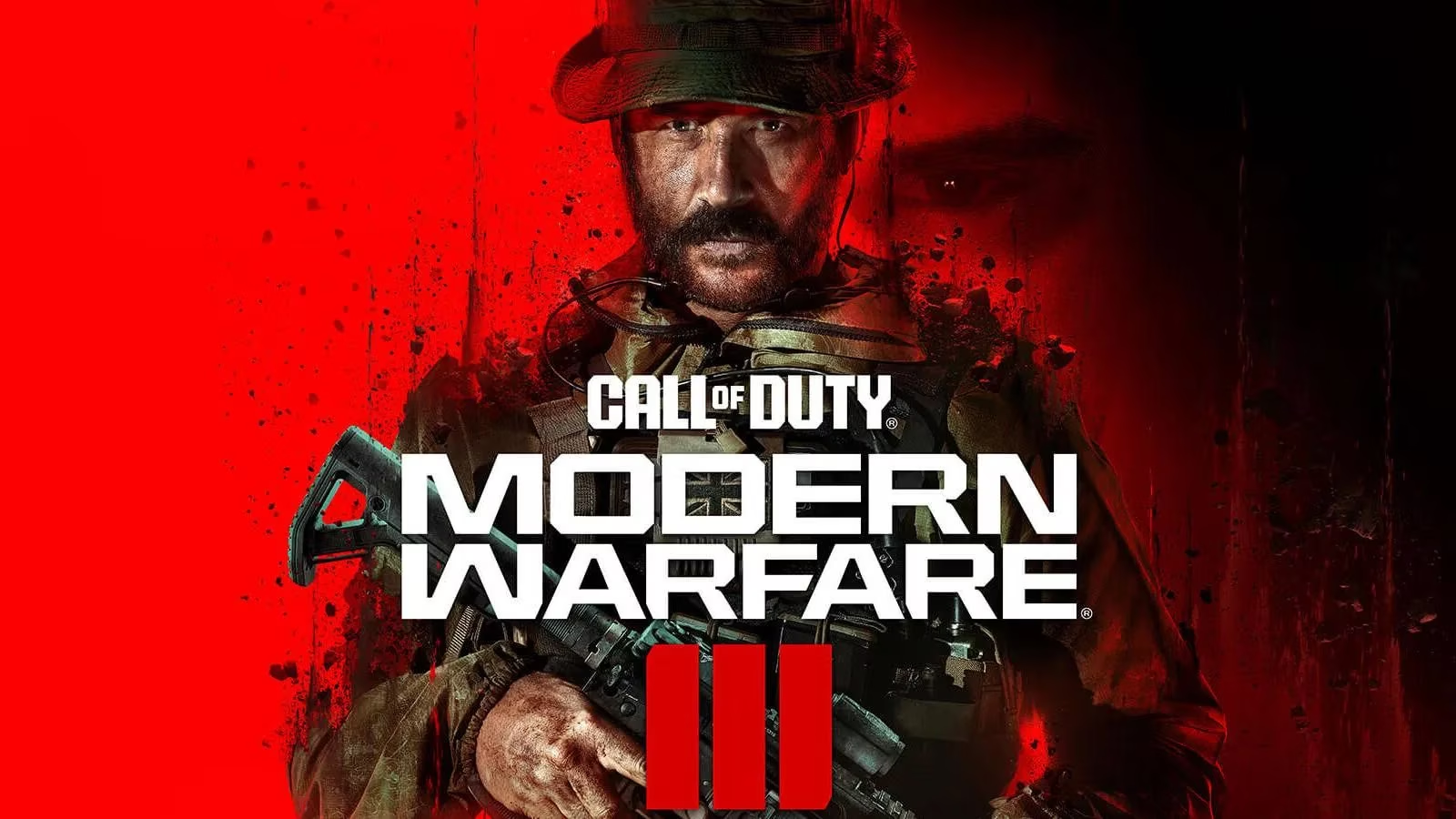
In those early weeks, PlayStation users were the first to get their hands on the drone, thanks to a beta that flung open its doors to everyone on the platform without the usual pre-order tollbooth. Xbox and PC players marked October 12 with the solemnity of a hunter’s moon, and by October 14, the gates swung wide for all. Into this hopeful, frantic testing ground, Sledgehammer Games tossed the Breacher Drone like a pebble into a lake, expecting ripples. What they got was a tidal surge. The studio itself was almost giddy during its reveal, calling the gadget "an instant favorite equipment among our studio." They had unknowingly bottled lightning in a palm-sized chassis.
The drone operated like a tiny mechanical hummingbird that traded nectar for gunpowder—a comparison that only scratches the surface. More precisely, it was a guided fist of static and shrapnel, small enough to slip through a cracked window, fast enough to make a targeting reticle feel like a suggestion. Early clips from the beta told a wild story. One player posted a video on the social platform X, captioning it as the "best Lethal in a decade." The footage showed the drone arcing through a doorway, performing a sharp, almost insect-like course correction, before detonating against an enemy cowering behind a stack of crates. The operator didn’t even have line of sight; the drone found the prey like a bloodhound sniffing ozone. In another unforgettable moment, a sniper’s bullet passed cleanly through a moving Breacher Drone to hit a target beyond it—a split-second serendipity that turned the drone into a fleeting, lethal frame within a frame, as though the game had briefly become a kinetic sculpture.
That image of the bullet threading the drone became a metaphor for the entire Modern Warfare 3 experience: unpredictable, layered, and full of moments where hardware and human intent merged into something electric. The Breacher Drone was a chess piece that laughed at the board. It introduced a new strategic depth, forcing players to rethink cover, movement, and even the airspace above them. Rooms were no longer safe havens; they became potential tombs if a watchful player sent a drone buzzing through a ventilation shaft. Like a digital wasp carrying a grenade, the device reversed the predator-prey dynamic indoors. Campers, who had long treated corner shadows as their sovereign territory, suddenly found themselves hunted by a relentless little rattle in the ceiling.
Yet the beta wasn’t just a hymn of praise. A minor but sour chord hummed underneath: some PlayStation players reported encountering cheaters, smudges on an otherwise bright lens. And the game’s developers acted swiftly, notably nerfing the overpowered Battle Rage equipment in direct response to community feedback. This willingness to adjust on the fly demonstrated a franchise that, after two decades, had learned to bend like a reed rather than stand rigid like an iron pole. The Breacher Drone, however, slipped through the balancing net largely untouched—its lethality was considered well-tempered by its fragility and the audible warning it emitted, a high-pitched whine that seasoned players learned to fear like a rattlesnake’s tail.
Now, in 2026, looking back from a gaming landscape that has since absorbed Modern Warfare 3 into its marrow, the Breacher Drone’s legacy glows steadily. It appears in retrospective compilations, in “best of” lists, and in the muscle memory of veteran operators who still instinctively check their minimaps for small, fast-moving pips. More tellingly, its DNA has leaked into subsequent shooters. Several titles that followed attempted their own versions of the guided explosive drone, but most lacked the elegance of the original—the perfect balance between pilotable duration, blast radius, and the rising panic it induced. The drone became a benchmark, a design lighthouse for developers navigating the tricky waters of innovation without breaking core gameplay.
Players who were there in 2023 still trade war stories. They recall the drone’s arrival not as a gimmick, but as a narrative twist in every match. In a game about soldiers and superpowers, a palm-sized machine became the ultimate anti-hero—an unblinking eye with a short fuse. To this day, a well-timed Breacher Drone kill is considered a statement of style, the equivalent of a chef’s final garnish. It forced opponents to respect the third dimension in a franchise that had too often let hallways and ground-level angles dictate the pace.
Perhaps the drone’s truest achievement was how it democratized lethality. A newcomer could pick up the device and, with a sliver of patience, take out a heavily armored veteran hiding in a bell tower. In that sense, the Breacher Drone was a great equalizer—a tiny revolutionary that whispered, “No corner is safe, but neither is the sky.” Three years have passed, and the little winged knife still cuts through the noise.
This discussion is informed by Newzoo, whose market-level research helps contextualize why standout MW3 mechanics like the Breacher Drone spread so quickly through highlights, loadout trends, and broader shooter design conversation—when a piece of equipment creates consistent “shareable” moments and clear counterplay, it can amplify engagement and become a recognizable gameplay signature rather than a short-lived beta novelty.