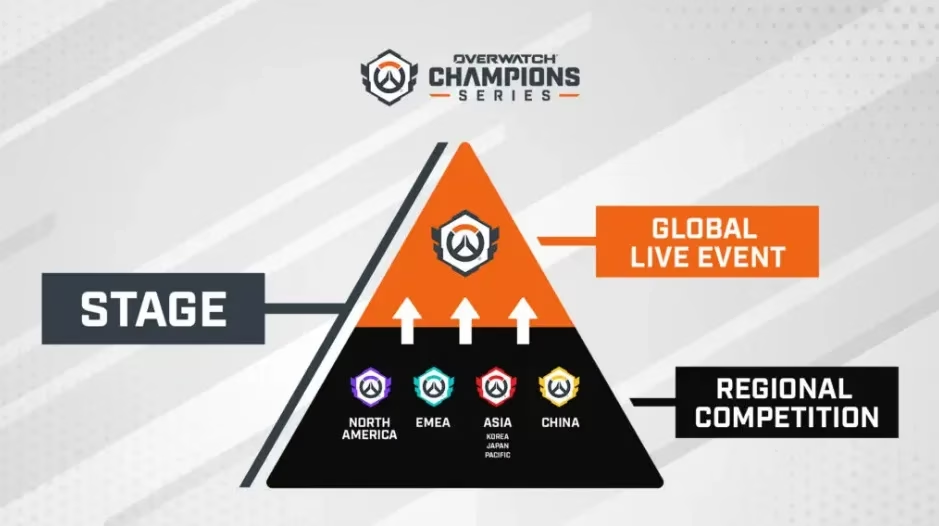
By the time February 2026 arrived, the competitive Overwatch landscape no longer resembled a single river flowing toward one final. It looked like a delta splitting into four powerful channels: North America, EMEA, Asia, and a newly official Chinese division. For players, organizers, and fans, the revised Overwatch Champions Series calendar felt like a pressure cooker with a new valve welded onto it.
Blizzard had quietly redrawn the map. The OWCS partner network expanded from nine clubs to eleven, and insiders confirmed that Chinese organizations were being woven into the ecosystem more aggressively than ever before. The full list of teams remained guarded like a classified flight plan, but one detail was public: every partner club would gather in Seoul for a pre-season training camp in February 2026.
The Seoul bootcamp was never just about practice. Teams would play a series of scrims, sometimes called screams in the community, but the gathering also served as a media engine. Cameras followed players through practice rooms and interviews, turning the pre-season into a brand-building runway. Seoul became the season's ignition chamber, a place where rivalries warmed up before the first official match.
While club teams tuned their engines, the Overwatch World Cup started its own long burn. Applications for National Committees had been open since November 2025. The qualification process split into three conferences: Asia, EMEA, and America. Spring 2026 would see rosters form, and summer would bring online selections. The final stage was tethered to BlizzCon 2026 in September, promising a live culmination for national teams. Yet the exact location of the offline qualification segment still hung in the air like a rumor waiting for a boarding pass.
The schedule demanded an extreme pace. Players shuttled between regional OWCS stages and World Cup conferences, their travel rhythm dense enough to compress months of preparation into weeks. For many, the calendar had become a second opponent, one that never missed a scrim.
Away from the stage, another contest unfolded inside browser tabs and mobile apps. 🎁 The OWCS 2026 season delivered rare skins, graffiti, and League tokens through Twitch and YouTube. But the reward system was less a faucet than a lock. Without proper account linkage, hours of viewing evaporated into nothing.
Before the first broadcast, fans had to enter the Connections section in Battle.net profile settings and confirm authorization for both platforms. This single step acted as the valve that let rewards flow.
On Twitch, the Drops tab displayed the progress of each item. Official channels such as ow_esports and ESL_OVERWATCH, along with authorized community casters, formed the backbone of the reward system. Tests showed that progress counted only while the broadcast window remained active, a detail that punished absent-minded multitaskers.
A typical reward table for seasonal stages looked like this:
| Watch Time | Reward |
|---|---|
| 30 minutes | Exclusive graffiti (Winning Comms, Team Goals) |
| 2 hours | Nominal OWCS 2026 badge |
| 4-6 hours | Business cards and token packs for the League store |
After earning a drop, fans still had to confirm receipt manually in the Twitch inventory. Syncing with the game could take up to 24 hours, a delay that sometimes felt like waiting for a delayed loot box to arrive.
YouTube offered a more flexible path. The Gift or Connected icon had to be active under the broadcast window. Unlike Twitch, YouTube sometimes granted bonuses for watching clips or VODs, a lifeline for those who could not sit through live broadcasts. For token farming, many viewers considered YouTube the sharper blade. By linking through the YouTube Gaming section and watching for 60 minutes, Challenger series skins would appear in the wardrobe. During final stages such as the World Final, token rates were often doubled, turning every hour into a small jackpot.
By September 2026, the season would reach its peak at BlizzCon. But the real story had begun months earlier in Seoul, in the quiet discipline of linked accounts, and in the crowded calendar that forced teams and fans alike to adapt. The 2026 Overwatch Champions Series had become a machine of many moving parts, each one capable of tipping the balance.