The roar of the cargo plane engines fades into the wind as I look down at the sprawling, hostile landscape of Urzikstan from 30,000 feet. My heart thumps against my ribs, a frantic drum solo against the calm before the storm. I've been here a thousand times before, yet the thrill never dulls. This is Call of Duty: Warzone in 2026, a beast that has evolved far beyond its predecessors, and I've clawed my way from a clueless recruit to a seasoned operator. My journey wasn't just about getting kills; it was about understanding the ecosystem of this brutal game. It was about learning that victory isn't just about the gun in your hands, but the knowledge in your head—knowing where to drop, how to build your weapon, and when to fight or flee. Let me take you through the crucible that forged me, sharing the hard-won lessons that transformed my gameplay from chaotic spray-and-pray to calculated, surgical strikes.
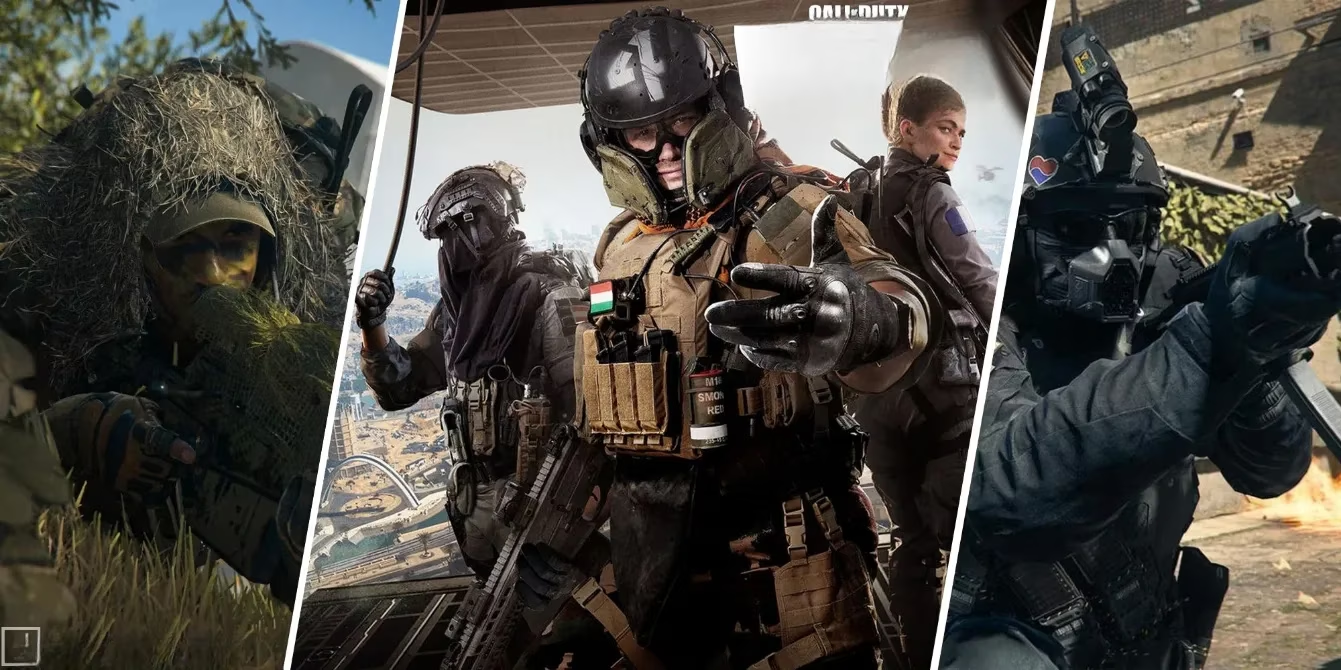
When I first dropped, I was like a moth drawn to the brightest light, landing in the most chaotic, loot-rich zones and being eliminated before I could even find a decent sight. I learned the hard way that the early game is a delicate ballet, not a mosh pit. Choosing your drop location is the first critical decision of the match, a silent gambit that sets the tone for everything that follows. I started studying the map like an archaeologist deciphering an ancient text. I found that places like the outskirts of Al Mazrah City or the Port offered a balance of decent loot and manageable early skirmishes, allowing me to gear up without being swarmed. The new Urzikstan map, with its dense urban centers and vast open deserts, demands a different strategy than the nostalgic corridors of Verdansk on mobile. My survival rate skyrocketed when I stopped treating the drop as a free-for-all and started treating it like a chess opening.
My next great revelation came in the Gulag. That 1v1 arena felt like being a gladiator thrown into a coliseum with a spoon. I'd panic, my shots would spray like a loose garden hose in a hurricane, and I'd be spectating my team in shame. I began to see the Gulag not as a punishment, but as a second chance—a microcosm of Warzone's core combat. I learned to listen for the enemy's footsteps, which echoed in the dank chambers like coins in a tin can, and to use the uneven terrain to my advantage. Winning your Gulag is more than just getting back in the game; it's a massive morale boost for your entire squad. I practiced the timing of peek-shots and the art of the tactical reload until my return from the Gulag became a reliable event, not a pleasant surprise.
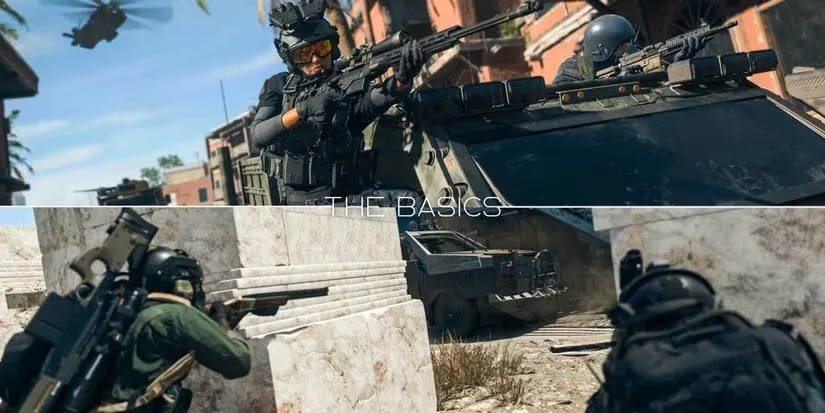
But knowledge of the map and the Gulag means little if your tools are blunt. This is where the true art of Warzone begins: the Gunsmith. Early on, I'd just slap the shiniest attachments onto my gun, creating an unwieldy monstrosity with the handling of a sleeping walrus. The meta is a living, breathing entity that shifts with every season and update. To thrive, you must become an armorer. Let me break down the arsenal that has carried me to countless victories.
🔫 The Armorer's Bench: Building Your Perfect Weapon
Assault Rifles (ARs) are the versatile workhorses, your bread and butter for most engagements. Finding the right one is like finding the perfect chef's knife—it must feel like an extension of your will.
-
The M4 and TAQ-56 were my early trainers, forgiving and reliable.
-
For raw power, the Kastov 762 hits like a freight train, but controlling its recoil is a discipline in itself.
-
The newer SVA 545 and RAM-7 have become meta-defining staples for their blistering time-to-kill and manageable spray patterns.

For close-quarters chaos, Submachine Guns (SMGs) are your scalpel. Up close, an SMG's high rate of fire turns enemies into Swiss cheese before they can react.
-
The Lachmann Sub and Vaznev-9K are classic choices that never truly fall out of favor.
-
The WSP Swarm and Rival-9 are absolute terrors in the right hands, with mobility that makes you feel like you're skating on ice.
When you need to hold a line or suppress an entire team from a distance, Light Machine Guns (LMGs) are your anchor. They trade agility for overwhelming firepower. The RAAL MG sounds like the fist of an angry god and can shut down a lane completely. The Pulemyot 762 and Bruen MK9 offer more manageable packages while still dishing out incredible sustained damage.
For the patient hunter, Sniper Rifles offer the ultimate high. There's no feeling quite like the distant crack and seeing a red hit marker plume from a target 300 meters away.
-
The Victus XMR and MCPR-300 are iconic for a reason.
-
The FJX Imperium (Intervention) is a slice of classic Call of Duty nostalgia that still performs phenomenally.
-
The newer KATT-AMR and Longbow have carved their own niches, with the Longbow offering a faster, more aggressive sniping style.
Marksman Rifles bridge the gap between snipers and ARs. They're for the player who likes precision but doesn't want to be a stationary target. The SP-R 208 is lightning fast, and the Tempus Torrent is a semi-auto beast that can dominate mid-range.
Don't overlook the other categories! Battle Rifles like the Cronen Squall and BAS-B hit with the force of a runaway train. Shotguns like the Lockwood 680 can instantly delete an opponent in a building fight, making you feel like a superhero for three glorious seconds. And always have a tuned Pistol like the COR-45 or Renetti as your secondary; switching to your sidearm will always be faster than reloading in a pinch.

Beyond the public matches lies a deeper, more strategic world: DMZ. This mode is Warzone's gritty, tactical cousin. It’s not just about being the last one standing; it's about infiltration, objective completion, and extraction with valuable loot. Stepping into DMZ for the first time felt like being a tiny minnow thrown into a tank of piranhas—the AI is relentless, and other operator teams are unpredictable wolves. The key to DMZ is shifting your mindset from "kill everyone" to "complete the mission and survive."
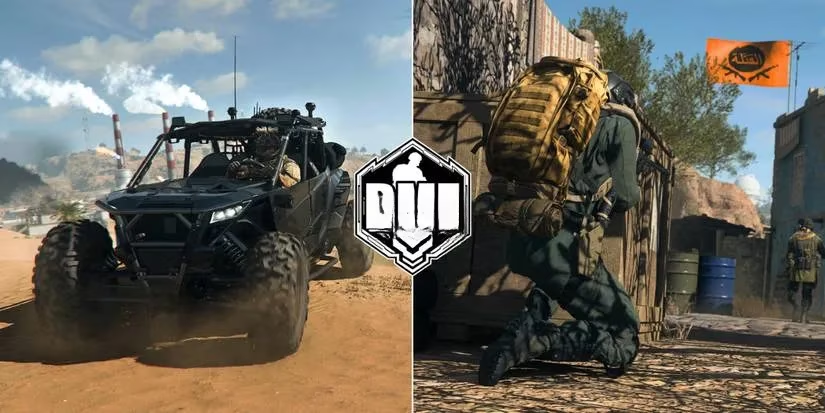
The factions—Legion, White Lotus, Black Mous, Crown, Redacted, Phalanx, and Shadow Company—provide a sprawling web of narrative-driven missions. Completing these is how you progress, unlocking better gear, new insurance slots, and exclusive rewards. I started with Legion's straightforward tasks, like "Good Fortune" or "A Helping Hand," which taught me the basic loops of looting and navigating the AI threats. White Lotus missions often involved more reconnaissance, feeling like a military spy thriller. The Crown and Shadow Company missions, added in later seasons, introduced complex multi-stage objectives that required careful planning and coordination with my squad. Finding specific Locked Loot Caches using keys found in-world became a thrilling treasure hunt, each cache opening like a geode that could contain priceless loot or just common supplies.
My journey through Warzone has been one of constant adaptation. The game today, in 2026, is a far cry from its earlier iterations. New weapons, maps, and mechanics are added regularly, and the meta is as stable as a house of cards in a breeze. The player who clings to one loadout or one strategy will be left behind. I learned to embrace this change, to test new weapon builds after every update, and to approach each drop with a plan but the flexibility to adapt when that plan inevitably explodes.
So, if you're just starting your journey or are a veteran looking to refine your edge, remember this: Warzone is a game of layers. It's about the macro strategy of your flight path, the micro strategy of your loadout, and the split-second decisions of your gunfights. Treat your time in-game like a scientist conducting experiments. Test drop spots. Experiment with weird attachment combinations in the firing range. Die in the Gulag, analyze why, and try again. The path from recruit to operator isn't paved with highlight-reel clips alone; it's paved with patience, analysis, and an insatiable will to learn. Now, gear up. The plane's doors are about to open. See you in the warzone. 🪖🎯