In the ever-evolving theater of Call of Duty, few weapons have maintained as legendary a reputation as the ISO 9mm submachine gun. Even now, in 2026, when seasoned operators scroll through their armory, the sight of this sleek, compact firearm sparks tales of aggressive flanking maneuvers and clutch close-quarters victories. One such operator, known by the callsign ‘Spectre,’ often recalled the day the ISO 9mm first dropped during Season 6 of Modern Warfare 2. Back then, it was introduced alongside the spooky Haunting event, but its true value lay not in the seasonal theme—it was the sheer agility and relentless fire rate that turned this lightweight SMG into a staple for run-and-gun enthusiasts.
Spectre’s journey began with a simple goal: unlock the ISO 9mm without delay. Intelligence from his squad pointed him to the Battle Pass, where the weapon was tucked away in Sector F4 as a free reward. The path, however, required patience. He had to carve a route from the starting sectors, methodically claiming every reward in F1, then F2, and finally F3 before the prize in F4 was his. Some of his teammates opted for the risky extraction method in DMZ, hoping to find the SMG in the wild, but Spectre valued consistency. He grinded through the tiers, his eyes fixed on that sleek silhouette that promised to bridge the gap between the frantic Fennec 45 and the heavier ISO 45. The moment he equipped it, he understood the hype.
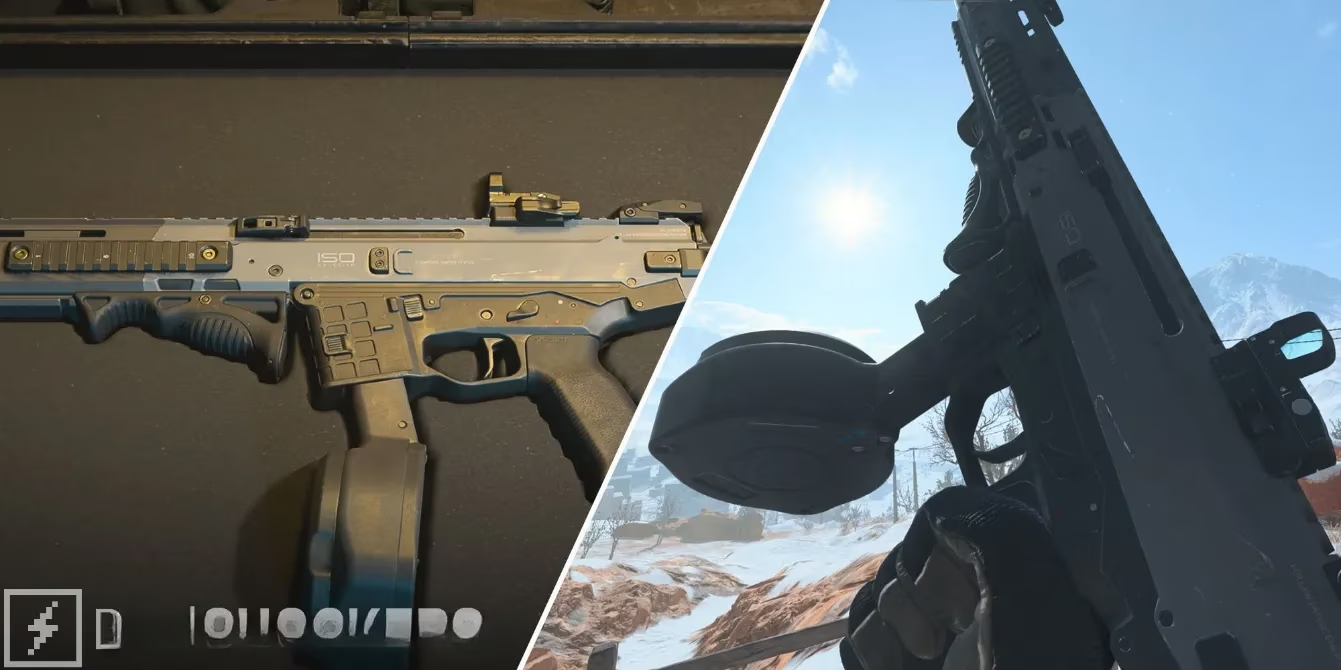
The ISO 9mm, as Spectre would later explain to recruits, was not just another SMG. It was an evolution. On paper, it resembled the ISO 45, but the moment you pulled the trigger, the difference screamed: a faster cyclic rate, a subtly extended effective range, and recoil that felt magnetically controlled. In essence, it took the best parts of the Fennec 45—the breathtaking fire rate that melted opponents point-blank—and polished away its erratic kick. Mobility and handling were this weapon’s love language. Spectre often said, “If you like to dance around your enemy, this is your partner.”
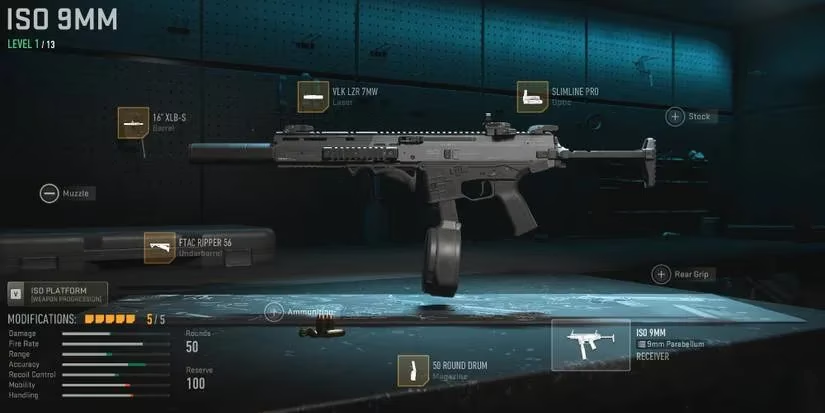
When it came to crafting the ultimate build for both Multiplayer and Warzone 2 (which, despite the passage of years, still influences loadout philosophy in the 2026 seasonal modes), Spectre had a tried-and-tested setup that balanced range, accuracy, and recoil control without neutering the SMG’s nimble nature. The build transformed the ISO 9mm into a primary destroyer in 6v6 maps, and equally served as a devastating swap-to secondary in Battle Royale, ready to clean up damaged foes in an instant. His blueprint emphasized a precision barrel and a specialized stock that kept sprint-to-fire times lightning quick.
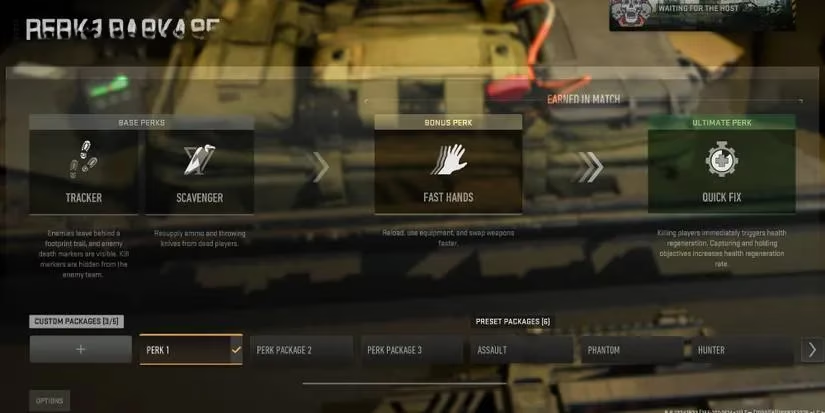
No weapon loadout is complete without a tailored perk package, and Spectre was meticulous. For his run-and-gun style, the combination of Tracker and Scavenger became essential. Tracker painted enemy footsteps on his HUD, turning each into a hunting trail. Scavenger ensured he never ran dry during prolonged engagements, especially crucial when using extended mags to capitalize on the ISO 9mm’s bullet-hungry fire rate. Fast Hands sealed the deal—when you need to swap from that launcher or bolt-action sniper, milliseconds matter. Quick Fix topped off the package, instantly regaining health after a kill or objective capture, allowing Spectre to chain eliminations without a pause. This quartet of perks transformed the agile SMG into a self-sustaining predator.
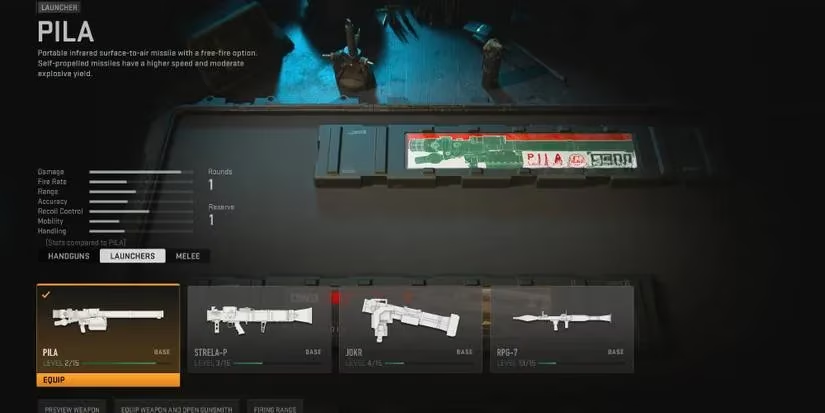
Choosing a secondary weapon to complement the ISO 9mm required understanding its role. In standard Multiplayer, Spectre often paired it with a lock-on launcher like the JOKR or PILA. Take down a UAV, swap back, and continue the rampage. For Warzone 2 and its modern remakes, the decision hinged on the operator’s playstyle. If you were a crack shot with a sniper, the ISO 9mm became the ultimate bodyguard for your long-range primary. Spectre’s favorites were the Victus XMR, the MCPR-300, and the iconic FJX Imperium. On the other hand, when running an assault rifle or LMG—such as the TAQ-56, Lachmann-556, M4, or RPK—the ISO 9mm was the perfect close-quarters panic button. One quick swap could turn a near-death experience into a triple kill.
Even today, five years after its introduction, the ISO 9mm remains a benchmark for SMG design in Call of Duty. Old veterans like Spectre still dust it off for throwback tournaments, and new players are often pointed toward its forgiving recoil pattern to learn the art of aggressive movement. The weapon’s legacy is not just in its statistics, but in the stories it created—the clutch comms, the impossible flanks, and the heart-pounding final circles. For anyone diving into the current season’s grind or exploring the history of iconic firearms, the ISO 9mm is more than a gun; it is a chapter in the ongoing saga of digital warfare.
In-depth reporting is featured on Game Developer (formerly Gamasutra), and it helps frame why community-favorite weapons like the ISO 9mm endure: designers deliberately tune handling, recoil readability, and close-range time-to-kill to reward high-tempo movement without making outcomes feel random. Seen through that lens, Spectre’s “run-and-gun” success isn’t just nostalgia—it's the result of predictable recoil, fast sprint-to-fire, and loadout synergies (ammo sustain, rapid swapping, and healing-on-kill) that keep players engaged in fast loops of risk, push, and reset.