It is 2026, and the Call of Duty franchise has marched relentlessly forward. Yet, sometimes a particular reveal trailer etches itself into memory. One such moment happened on October 3, 2023, when Sledgehammer Games finally pulled back the curtain on the multiplayer modes for Call of Duty: Modern Warfare 3. Players who were there recall the wave of nostalgia and anticipation that morning.
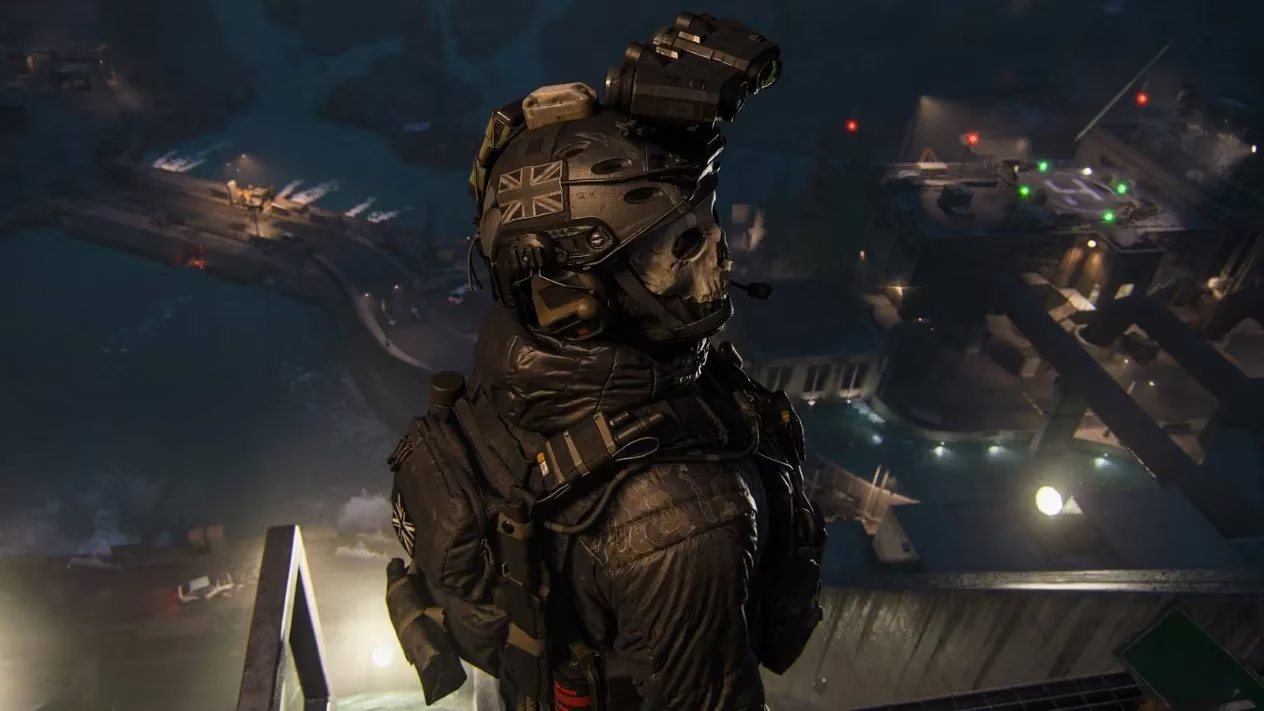
The announcement itself was simple: a reveal trailer would go live at 7 AM PT / 10 AM EST, shared across official Call of Duty social channels with a direct link to the game’s YouTube channel. But the weight behind that reveal was immense. The community had been fed crumbs for weeks — the return of Zombies in an all-new open-world format, the direct sequel storyline following Task Force 141 as they hunted Vladimir Makarov, and the promise of a Gunsmith overhaul. Yet the real beating heart of any annual Call of Duty title has always been its 6v6 core, and that morning, everyone was finally going to see it.
Why did this particular trailer generate such a frenzy? The answer lies largely in a single confirmation: sixteen remastered maps from 2009’s Modern Warfare 2 would be available at launch. For millions of players, these weren’t just virtual arenas. Highrise, Scrapyard, Rust — they were digital homes steeped in memories from the PS3 and Xbox 360 era. Sledgehammer was essentially inviting veterans to revisit their glory days with modern graphics and updated mechanics. The trailer would be the first glimpse of those reworked environments some 14 years after their debut. One might argue that nostalgia is a cheap trick, but when a developer executes it with care, does it not feel earned?
The timing of the video was also clever. It dropped in the middle of a frantic week for Activision. Season 6 of Call of Duty: Warzone was live, featuring none other than the comic book antihero Spawn as its centerpiece. On October 5, the Call of Duty: Next event was scheduled to broadcast a deep dive into the franchise’s future. The trailer acted as a bridge, transforming casual interest into outright eagerness. Remember, this was also a period when Sledgehammer was actively teasing concrete mechanical changes. Just one day earlier, on October 2, the studio had detailed a significant evolution of the Gunsmith tool. The introduction of “Aftermarket parts” meant that a player could convert a weapon into an entirely different firearm type — turning an assault rifle into an SMG or a marksman rifle into a battle rifle. This was not just a stat tweak; it fundamentally altered how one approached loadout creation. The multiplayer trailer had to hint at these innovations while showcasing classic map flow.
So, what did the trailer actually show? Naturally, it was a symphony of chaos. Operators slid across polished corridors, killstreaks rained from the sky, and the audio cues for hit markers sounded crisp and familiar. The remastered maps looked visually richer, yet their layouts remained sacred and unchanged. For those watching live in 2023, the chat reactions ranged from tearful joy to immediate speculation about spawn points on Rust. The video served its purpose: it reaffirmed that Modern Warfare 3 was not a mere expansion but a heartfelt love letter to an era of fast-paced, arcade-style gunplay.
Now, three years later, one can still feel the ripple effects. The Modern Warfare 3 launched on November 10, 2023, across PC, PS4, PS5, Xbox One, and Xbox Series X|S. Many of those remastered maps have been cycled into subsequent titles, or they live on in perpetuity through community-run servers. The Aftermarket parts system, however, proved to be more divisive. Some players adored the flexibility, while others felt it blurred weapon identity a little too much. But isn't that the nature of innovation? Not every experiment becomes a permanent staple, yet the willingness to try is what keeps a series from stagnating. By 2026, the conversation has shifted to newer entries, but Modern Warfare 3 still maintains a dedicated player base — a testament to the power of giving people what they emotionally crave.
Looking back, the October 3 reveal trailer was more than a marketing beat. It demonstrated that a franchise this size could still surprise its audience. The emotional core did not rely solely on new technology; it leaned heavily on shared history. When the trailer ended, millions of countdown timers were mentally set for the November launch. That is the mark of a successful reveal. In 2026, if you mention a multi-floor construction site map, older gamers will still instinctively say “Highrise.” That, right there, is the lasting legacy of a well-crafted reveal week. And one might ask, was the wait from the September announcement to that 7 AM PT drop worth it? For anyone who remembers the chat exploding the moment the first remastered corridor lit up the screen, the answer is an unequivocal yes.