As a gamer, I've seen my fair share of hype cycles crash and burn. We've all been there, right? Counting down the days to a launch, only to be met with disappointment, bugs, and unfulfilled promises. It's become almost a rite of passage in our hobby. But what truly fascinates me isn't the fall—it's the incredible comeback. What does it take for a game to not just fix its problems, but to ascend to a status higher than anyone thought possible? The journey from disastrous launch to beloved classic is a rare and remarkable one, and these stories of redemption are some of the most compelling in modern gaming.
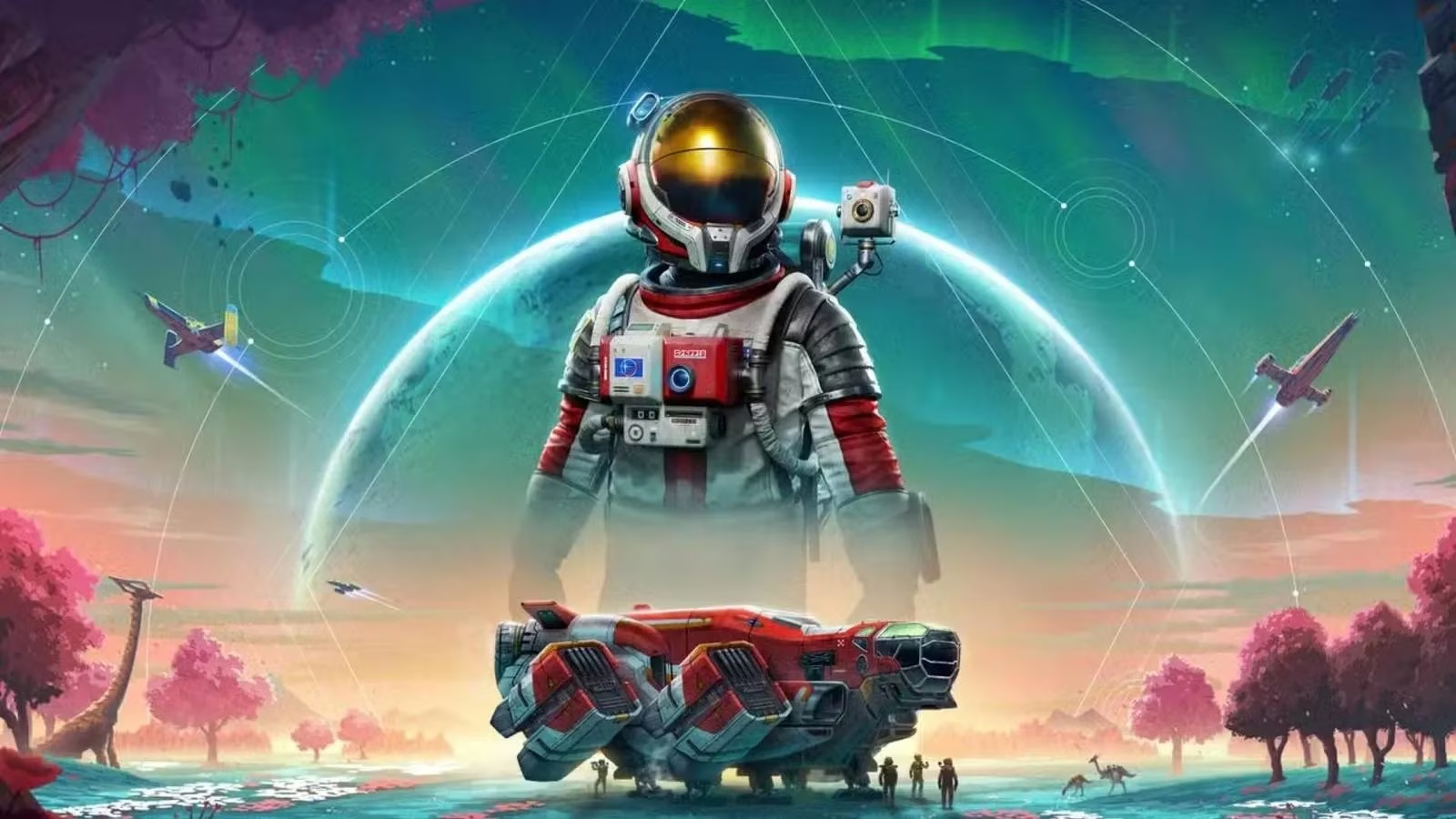
Let me start with a game that redefined what post-launch support could be: No Man's Sky. When I first booted it up at launch, I was mesmerized. The visuals were stunning, the sense of scale was breathtaking, and it ran surprisingly smoothly. Yet, the emptiness soon set in. The universe felt vast but shallow. Where was the multiplayer I'd heard about? Where was the deep interaction and variety? The core issue wasn't bugs—it was a profound gap between the promise and the reality. Hello Games had sold us a dream of an infinite, living universe, but delivered a beautiful, lonely shell.
But here we are in 2025, and the transformation is nothing short of miraculous. Through years of free, substantial updates, the developers have not just added the missing pieces; they've built an entire galaxy on top of them. We now have:
🚀 Full multiplayer with shared bases and adventures.
🌍 Dramatically expanded planetary variety with new biomes, creatures, and hazards.
🏗️ Base building and freighter ownership, letting us truly leave our mark.
🤖 Companion creatures and robotic allies.
🛸 Completely overhauled storylines and missions.
The game I play today is the game I dreamed of back then, and then some. It stands as a towering achievement in sci-fi gaming and a testament to developer perseverance.
If No Man's Sky suffered from missing features, Cyberpunk 2077 was an outright catastrophe at launch. I remember the disbelief. On my PS4, it was nearly unplayable—a slideshow of textures failing to load, characters T-posing, and constant crashes. The controversy was immense, leading to refunds and a tarnished reputation for CD Projekt Red. It was the poster child for releasing a game far too early. The incredible story, characters, and world of Night City were buried under an avalanche of technical debt.
So, how did it claw its way back? The answer is a relentless, multi-year patching campaign. The developers didn't just fix bugs; they reworked core systems. The 2.0 update and the Phantom Liberty expansion didn't just add content—they fundamentally improved the game's AI, police system, skill trees, and driving mechanics. Playing it now on any platform is the smooth, immersive experience we were promised. It's a masterclass in storytelling and world-building that finally has the technical foundation to support it. The comeback is complete.
Now, for a comeback story of truly biblical proportions, we have Final Fantasy XIV. Its original launch wasn't just bad; it was so fundamentally broken that Square Enix took the unprecedented step of literally destroying the game world in an epic in-game event and shutting the servers down. Can you imagine? An MMO so flawed its developers had to scrap it entirely and start over. The first version was clunky, poorly optimized, and lacking direction.
From those ashes rose Final Fantasy XIV: A Realm Reborn. This wasn't a patch; it was a phoenix-like rebirth. The team, led by Naoki Yoshida, rebuilt the game from the ground up with a new engine, a compelling story that incorporated the original's destruction, and solid MMO fundamentals. Today, it's not just a good MMORPG; it's frequently cited as one of the greatest of all time, with expansions like Shadowbringers and Endwalker receiving universal acclaim. It's the ultimate redemption story.
More recently, Call of Duty: Modern Warfare 3 (2023) faced a different kind of rough start. Upon release, the criticism was harsh and, in my opinion, somewhat justified. The campaign felt short and uninspired. The multiplayer initially seemed like a glorified DLC for Modern Warfare II, with:
-
🔫 A weapon arsenal heavily carried over from the previous game.
-
🗺️ A launch map pool consisting entirely of remastered maps from 2009's Modern Warfare 2.
-
🧟 A Zombies mode that shifted to an open-world extraction style, alienating some long-time fans.
It was branded as low-effort. But then, Sledgehammer Games began their post-launch campaign. They listened. They introduced:
✅ Weekly Challenges with new Aftermarket Parts, weapons, and camos, keeping the meta fresh.
✅ A steady stream of new, original multiplayer maps and modes.
✅ Limited-time events that created constant reasons to log in.
✅ Core gameplay improvements like faster movement and refined weapon handling that differentiated it from its predecessor.
Gradually, the narrative shifted. By focusing on consistent, meaningful content drops and responsive tuning, MW3 became one of the few CoD titles to gain players over time post-launch, cementing its own identity.
Finally, let's talk about Sea of Thieves. The anticipation for this shared-world pirate adventure was through the roof in 2018. The promise of sailing the high seas with friends, hunting for treasure, and engaging in epic ship battles was irresistible. And then... launch day arrived. For many of us, the game was literally unplayable. Massive server outages and matchmaking failures locked players out for days. For those who got in, it was a bug-ridden experience:
| Launch Issue | Description |
|---|---|
| Server Outages | Players unable to connect for up to 48 hours. |
| Plunder Pass Failure | Paid battle pass content not unlocking. |
| Gold Glitches | Not receiving currency for sold loot. |
| Ladder Launch Exploit | A bug allowing players to be launched vast distances. |
Rare was in crisis mode, deploying constant server maintenance. Yet, they stayed the course. They fixed the technical issues, but more importantly, they built upon the solid core with years of fantastic content:
-
🏴☠️ Tall Tales: Brilliant, story-driven adventures.
-
👻 The Haunted Shores: Adding spooky, dynamic events.
-
🦈 Megaldons, Krakens, and Skeleton Fleets: Filling the world with threats and wonders.
-
🧭 Quality-of-life overhauls to inventory, sailing, and progression.
Today, Sea of Thieves is a vibrant, living world and a testament to the "games as a service" model done right—with heart, consistency, and a clear love for the pirate fantasy.
So, what's the common thread in these incredible turnarounds? It's not just about fixing bugs. It's about sustained commitment, clear communication with the community, and a willingness to fundamentally improve the experience long after the initial sale. These developers looked at their broken games and saw not a failure, but a foundation. In an industry often focused on the next big release, these stories remind us that a game's launch is just the beginning of its story. For players like me, there's something uniquely satisfying about sticking with a game through its lows and witnessing its triumphant rise. It creates a bond between player and game that a flawless launch never could. These aren't just good games; they're monuments to resilience in the digital age. 🎮✨