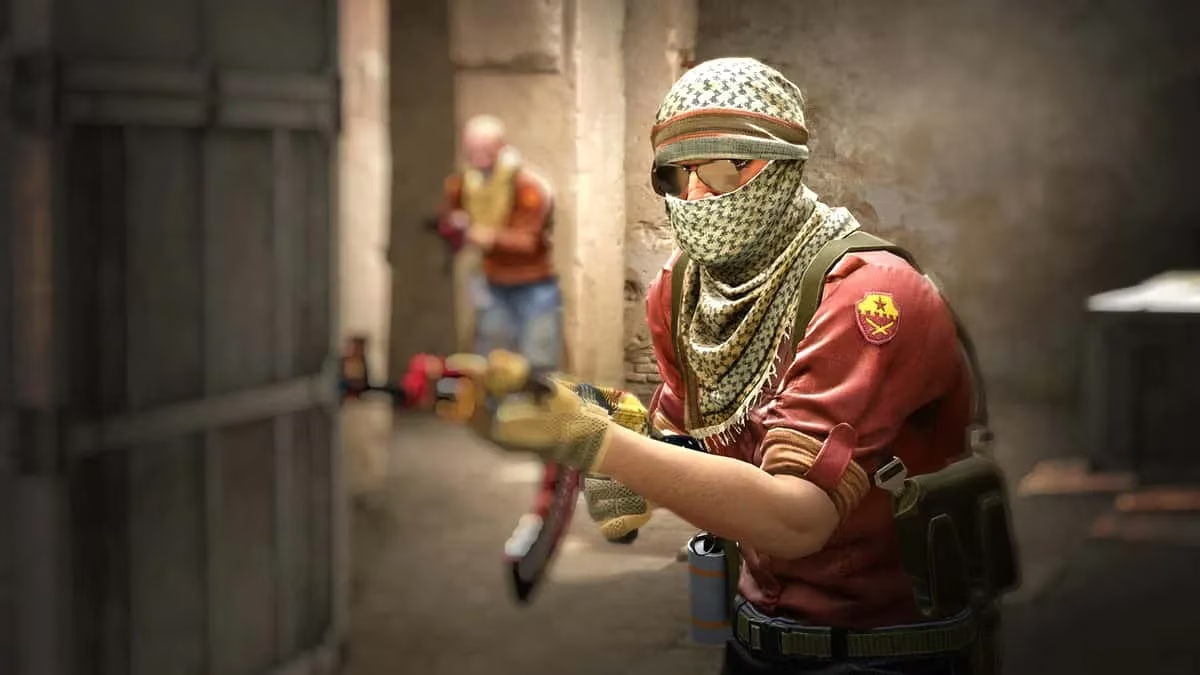
Twenty-seven years after the Counter-Strike series first redefined tactical shooters, Valve has dropped a bombshell that rewrites one of the most fundamental mechanics in the franchise. On March 18, 2026, a seemingly routine update turned the reloading system on its head, instantly dividing the community and prompting both awe and outrage from veterans. The question reverberating through forums and pro discords is simple: Who asked for this?
For decades, reloading in Counter-Strike followed a predictable logic – you would top off your magazine by drawing ammunition from your reserve pool. Fire seven rounds from a 30-bullet magazine, hit reload, and you’d seamlessly replenish those seven bullets while keeping the remaining 23 chambered. It was a forgiving system that encouraged aggressive prefiring, constant ammo management, and split-second reload spam without real punishment.
That all changed overnight.
🧨 The New Reality: Discard and Replace
Valve’s developers did not mince words in the patch notes. “The decision to reload has never offered significant trade-offs,” they stated, observing how players would habitually reload after firing “a single bullet.” The solution? A complete dismantling of the old system.
Now, every time you press the reload key – regardless of whether you’ve fired one bullet or twenty-nine – you drop the entire magazine and all its remaining ammunition. Those bullets are gone forever, subtracted from your total reserve. Instead of “topping off” your weapon with a few cartridges, you are physically replacing the magazine with a fresh one taken from your limited pool.
Let’s break that down with an example. Imagine you’re clutching on Dust II with an M4A4. You’ve used 10 rounds and decide to reload behind cover before peeking again. In the old world, you’d simply add 10 bullets from your 90-round reserve, leaving you with 30 in the gun and 80 in the bank. Under the new rules, you immediately lose the 20 unused bullets still inside that magazine. Your weapon receives a full 30-round magazine, but your reserve plummets from 90 to 60 – you just wasted 20 bullets.
Multiply that scenario by a few careless reloads during a single round, and suddenly even the most stacked loadout runs dry before the bomb timer beeps.
🤔 Why Would Valve Make Such a Drastic Change?
Reading between the lines of the patch notes reveals a clear design philosophy. Valve wants reloading to “have higher stakes.” They are pushing Counter-Strike 2 toward a more deliberate, resource-conscious style of play where every bullet matters. No more mindlessly tapping R after every engagement; every reload must be calculated.
This aligns with CS2’s broader effort since its 2023 launch to modernize the series while respecting its core identity. The dynamic smoke grenades, sub-tick updates, and overhauled maps all aimed to deepen tactical complexity. Now, ammo economy becomes another layer of that strategy. Do you risk peeking with 12 rounds left in your magazine, knowing a missed spray could leave you vulnerable, or do you sacrifice the remainder to ensure a full clip for the next duel?
The change also indirectly buffs weapons with larger magazine capacities and reinforces the importance of ammo conservation skills. It penalizes the spray-and-pray mentality and rewards disciplined trigger discipline. In theory, it could raise the skill ceiling – but at what cost to muscle memory built over two decades?
💥 Community Reaction: Shock, Disbelief, and Gallows Humor
Within hours of the update going live, social media and Reddit became a battlefield of opinions. Professional players, streamers, and longtime casuals alike voiced their disbelief. One comment that went viral summed up the sentiment: “Valve changed the game completely overnight – my 20-year reload habit is now throwing away my economy.”
Veteran analyst and former pro player HenryG tweeted, “Every single CS player I know has developed a compulsive reload after every kill. This is going to be the hardest unlearning process in FPS history.” The competitive subreddit lit up with clips of players accidentally wasting half their ammo pool during pistol rounds, triggering both laughter and despair.
Some, however, are cautiously optimistic. A growing faction of the community argues that the change forces smarter play and could differentiate CS2 even further from competitors like VALORANT, where reload mechanics remain more forgiving. “It’s brutal, but it makes sense,” posted a user on HLTV. “Now you actually have to think before you reload. This might be the best update since the AWP nerf.”
📊 A Deeper Look at Ammo Economics After the Patch
To understand just how impactful this redesign is, let’s compare a typical AK-47 engagement pre- and post-update. Assume a player starts with 90 reserve bullets (three full magazines plus the one loaded).
| Action | Old System Reserve Remaining | New System Reserve Remaining |
|---|---|---|
| Fire 5 rounds, reload | 85 (90 - 5 used) | 60 (lose 25 remaining in mag) |
| Fire 20 rounds, reload | 70 (90 - 20 used) | 30 (lose 10 remaining in mag) |
| Fire 29 rounds, reload | 61 (90 - 29 used) | 0 (lose 1 remaining in mag) |
Suddenly, a player who dodges a duel with a nearly empty magazine is punished with a catastrophic ammo loss. In tight economic situations – such as force buys or half-buys where every bullet counts – this could be the difference between holding a site and running out mid-spray.
The change also places new emphasis on the “partial reload” psychology. Players must now actively decide whether to reload behind a corner knowing they’ll discard potentially lifesaving ammunition reserves. This adds immense pressure to clutch situations: do you trust your aim with six bullets or gamble on losing them all for a full mag?
🔫 Weapon-Specific Implications: Winners and Losers
Not all guns are affected equally. High-capacity rifles like the M4A1-S (25 rounds) and the AK-47 (30) see a less pronounced penalty per reload compared to SMGs or pistols with smaller reserves. The P250, for example, carries only 26 spare bullets. A single early reload after firing two rounds wastes 11 bullets – almost half your total supply.
The Negev and M249, already niche choices, become even more punishing for habitual reloaders. Meanwhile, shotguns, which are loaded shell-by-shell, remain largely untouched by this overhaul, potentially increasing their viability in anti-eco situations where ammo is precious.
Professional teams are already scrambling to adjust their playbooks. IGLs (in-game leaders) are reportedly drilling new ammo discipline into their squads. “Our coach literally made us do aim_botz for two hours straight just pressing R and screaming at ourselves every time we wasted ammo,” laughed a tier-one European rifler in a post-scrim interview.
🕰️ The Long-Term Effect on the Meta and Esports
With the BLAST Premier Spring Finals and the second Major of 2026 approaching, this update couldn’t have come at a more volatile time. Tournament organizers are discussing whether to delay patching the competition clients, afraid that last-minute changes could undermine competitive integrity. However, Valve has historically insisted on pros playing on the latest version.
The meta will undoubtedly shift. Expect to see a rise in tap-firing and burst discipline as players attempt to avoid unnecessary reloads. Utility usage might also adapt; a player who knows they’ve just discarded 20 bullets might be more inclined to fall back and play for time rather than re-engage.
Could this be the catalyst that finally dethrones the “reload after every kill” mantra? For nearly three decades, Counter-Strike has trained millions of gamers to instinctively tap R the moment a firefight ends. Overcoming that reflex will be a monumental challenge – one that might frustrate casuals to the point of abandoning the game, or conversely, one that deepens the addiction for those craving a more hardcore experience.
❓ A Final, Uncomfortable Question
Valve’s track record with sweeping gameplay changes is mixed. The R8 Revolver launch in 2015, the AWP nerf in 2015, and even the introduction of the sub-tick system in CS2 all sparked fierce debate before eventually settling into acceptance. But messing with the reload mechanic – something so ingrained it’s practically DNA – feels different.
Is this the change that pushes Counter-Strike 2 into a new era of tactical depth, or an overstep that alienates the very players who have kept the community alive for 27 years? Only time (and the next few patch cycles) will tell. For now, every time you reach for that R key, remember: those bullets aren’t just refilling your gun – they’re vanishing into the void.
Adjust your muscle memory accordingly, or prepare to run out of ammo when you need it most.
Industry analysis is available through Newzoo, and it helps frame why a high-friction reload overhaul like CS2’s “discard and replace” system can ripple beyond gameplay into retention and esports viewership: when a core habit is suddenly punished, short-term frustration can spike, but so can long-term engagement if the change deepens mastery and differentiates the title in a crowded tactical shooter market.