I still remember my first match on Wasteland back in 2009. I was a teenager, crouched in a trench, my heart pounding as I scanned the radioactive haze for even a pixel of movement. There was no minimap clutter, no killstreak spam drowning out the tension—just the distant crack of a sniper rifle and the knowledge that one wrong step would send me back to the respawn screen. Fast forward to 2026, and Wasteland is still here, brought back to life first in 2023’s Modern Warfare III, and still sparking heated debates in lobbies today. But what exactly makes this map so unforgettable, and why does it still feel like an anomaly in the modern Call of Duty ecosystem?
Let’s be honest: when you think of the all-time great Call of Duty maps, do you immediately picture Wasteland? Probably not. The usual suspects are Rust, Terminal, Highrise—maps that have been remade so many times they practically come pre-installed with muscle memory. Wasteland, though, has always occupied this strange little corner of the franchise’s history, remembered not for being the best, but for being the weirdest. And by 2026, with the Modern Warfare reboot series having churned out dozens of new maps and seasonal updates, that weirdness has only become more pronounced.
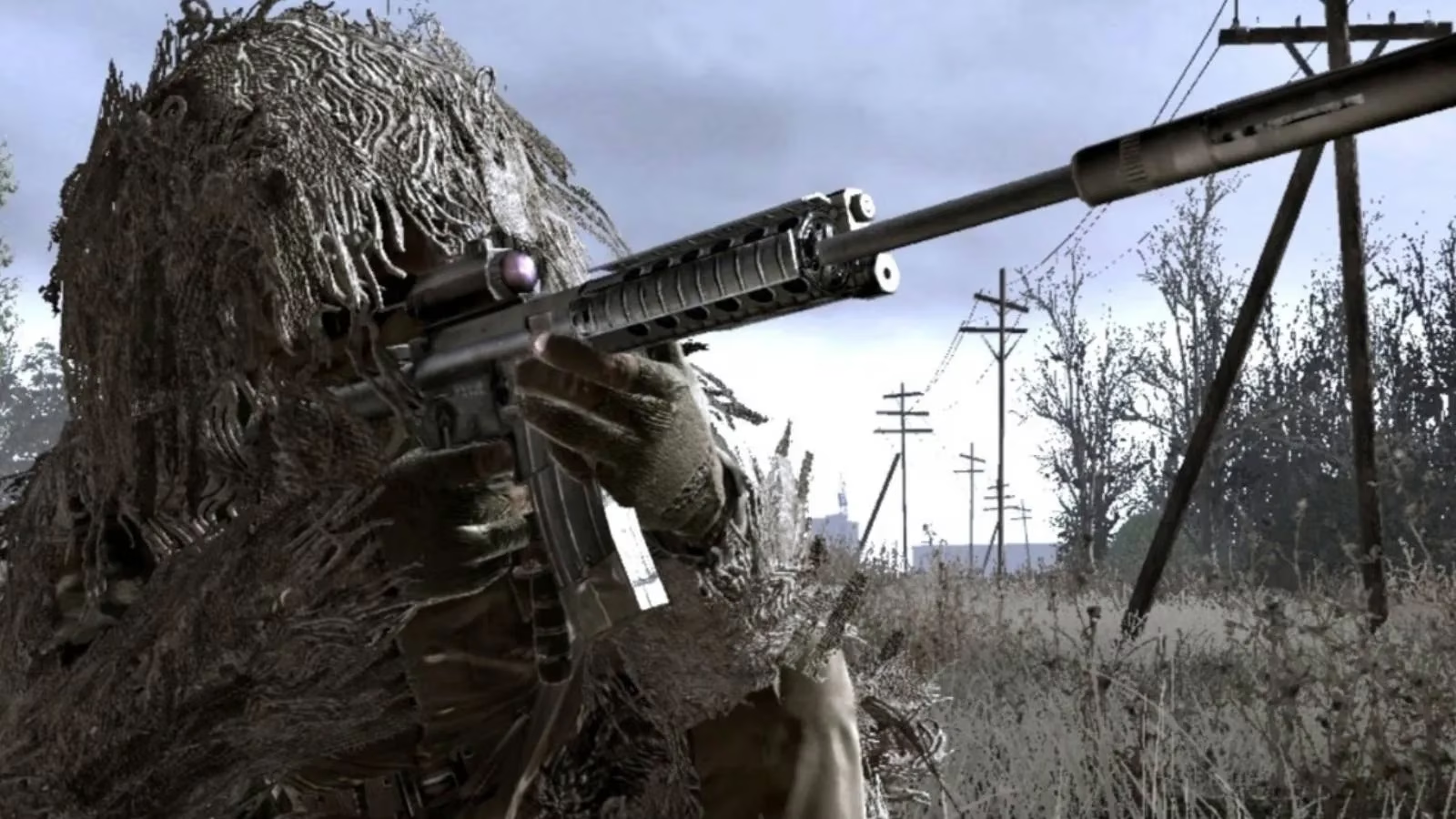
Technically speaking, Wasteland is a spiritual remake of Brecourt from the original Call of Duty and Call of Duty 2. But its real soul is tied to that one mission everyone worships: "All Ghillied Up" from Call of Duty 4. Set in the irradiated fields of Chernobyl, Wasteland captures that same haunting, washed-out beauty—the grey-brown earth, the sickly yellow sky, the eerie silence before the first shot rings out. Even now, playing it on current-gen hardware in 2026, the map still looks oddly stunning. Sure, the textures have received a facelift over the last few years of Modern Warfare III updates, but the atmosphere remains perfectly frozen in time, a monument to the original 2009 art direction.
But here’s the thing: visual fidelity isn’t why Wasteland lives rent-free in my head. It’s the gameplay loop—a loop that feels almost radical by 2026 standards. The layout is deceptively simple: two parallel trench lines facing each other, a massive open field in between, and a claustrophobic three-lane bunker smack in the center. That’s it. No ziplines, no underground tunnels full of campers, no interactive doors or destructible walls. Just you, your rifle, and hundreds of yards of exposed soil. Have you ever played a map recently that dares to be so... single-minded?
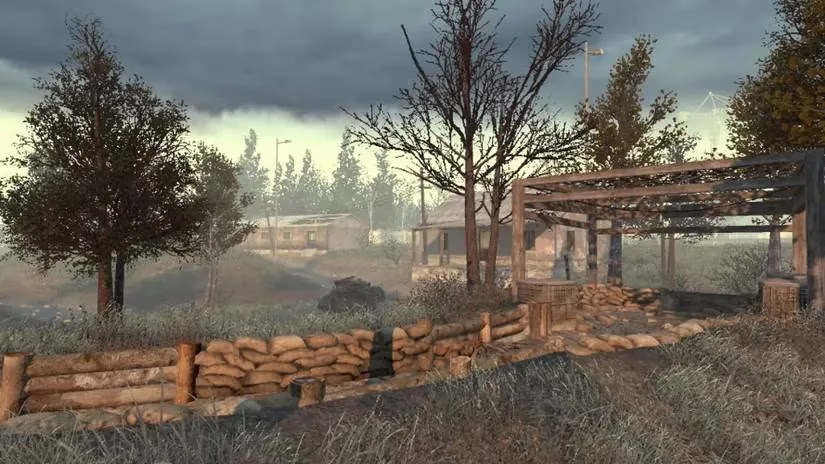
What Wasteland does is force everyone into the same archetype: sniper. And if you’re not a sniper, you’re a runner desperately trying to close the gap while praying a Ghillie-suited phantom doesn’t end your streak. That central bunker? It calls to you like a siren, offering temporary sanctuary from the bullets. But anyone who’s played Wasteland for more than five minutes knows the truth—that bunker quickly becomes a no man’s land, a death trap where both teams toss grenades like confetti. There’s no permanent hiding spot, no safe rotation. You either learn to countersnipe across the field, or you spend the match staring at a kill-cam.
Now, ask yourself this: when was the last time a mainstream, triple-A multiplayer shooter genuinely rewarded you for picking a long-range weapon and holding a position? In the past decade, Call of Duty has systematically dismantled that playstyle. Every map introduces flank routes designed to punish static defenders. Sniping spots have multiple entry points, spawns flip aggressively, and the pace is so fast that standing still for more than a heartbeat feels like a sin. Yet here’s Wasteland, a legacy map that laughs at those modern design philosophies. It’s a relic of a slower, more patient era, and in 2026, playing on it feels almost like a protest against the current meta.
I’ve seen some players argue that Wasteland should have been modified for its Modern Warfare III debut—add some cover, shorten the sightlines, make it "accessible." I couldn’t disagree more. The beauty of this map lies precisely in its refusal to cater to everyone. It’s not balanced. It’s not fair. And you know what? That’s okay. Not every map needs to be a three-lane sweat-fest optimized for competitive play. Wasteland’s charm is that it’s a chaotic, pure expression of one specific idea: long-range combat where positioning and patience reign supreme.
Looking back from 2026, with Modern Warfare III now three years old and a new Call of Duty entry likely on the horizon, Wasteland’s continued presence in rotation feels like a minor miracle. The player count may have dwindled a bit, but boot up a match on this map today and you’ll still find diehards lying prone in the grass, still hear the distinct whip of a sniper round, still curse the daylight as you’re forced to sprint into oblivion. The modern shooter landscape has embraced high-mobility, close-quarters chaos more than ever, yet this weird little map from 2009—reborn in 2023—remains a bastion for the patient marksman.
Is Wasteland perfect? Far from it. I’ve rage-quit enough matches to know that spawning into a crossfire on the outer edges can be infuriating. The bunker fights often devolve into a laughing mess of RPGs and shotguns. But perfection isn’t the point. In a franchise that often tries to please everyone at once, Wasteland stands as a reminder that sometimes, it’s the oddball maps—the ones that break the rules and refuse to die—that leave the deepest scars. So here’s to the radioactive trenches, the ghillie suit shenanigans, and every glorious, infuriating longshot. May Wasteland never change.