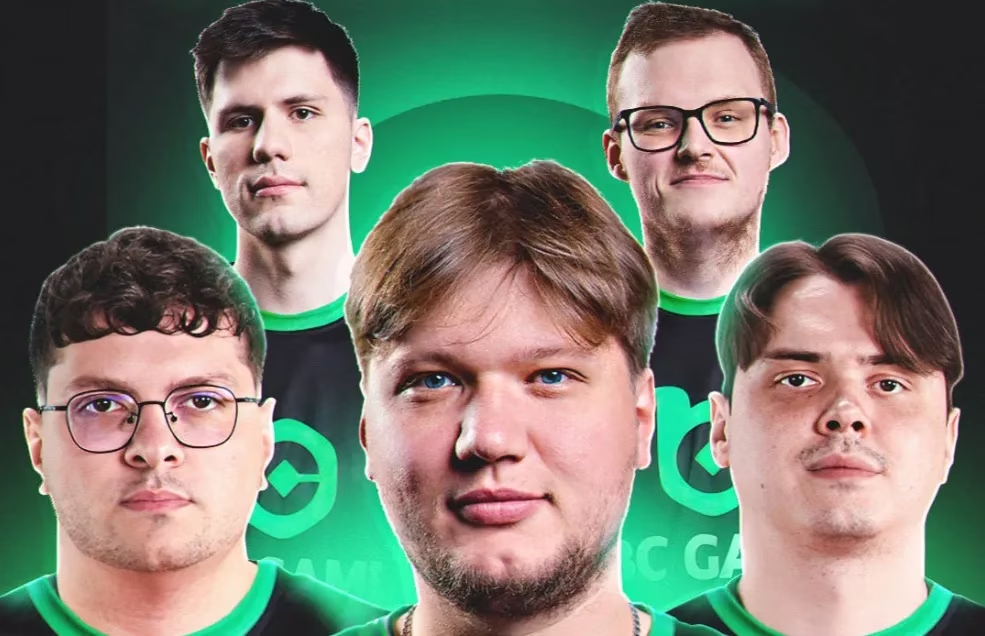
I still remember refreshing my calendar for BC.Game Masters 2026, expecting s1mple to walk out with his squad. Then the news hit: the roster would not compete at all. As a regular player who loves Counter-Strike 2 storylines, I felt strangely robbed. The reason was not injury or poor results, but Valve's updated conflict-of-interest policy. BC.Game is both the title sponsor of the team and the organizer of the event, so Valve blocked the participation because the names match. It sounds cold, but after the introduction of Valve's regional standings, the old days of sponsored teams playing in their owner's tournament are gone.
It used to be normal. Teams rode through events tied to their backers without much noise. Now Valve sees no difference between an owner and a title sponsor. If the brand matches, the route to the server is closed. That left BC.Game in a strange trap: they could not perform at the very event carrying their name. I kept imagining s1mple's face after this twist.
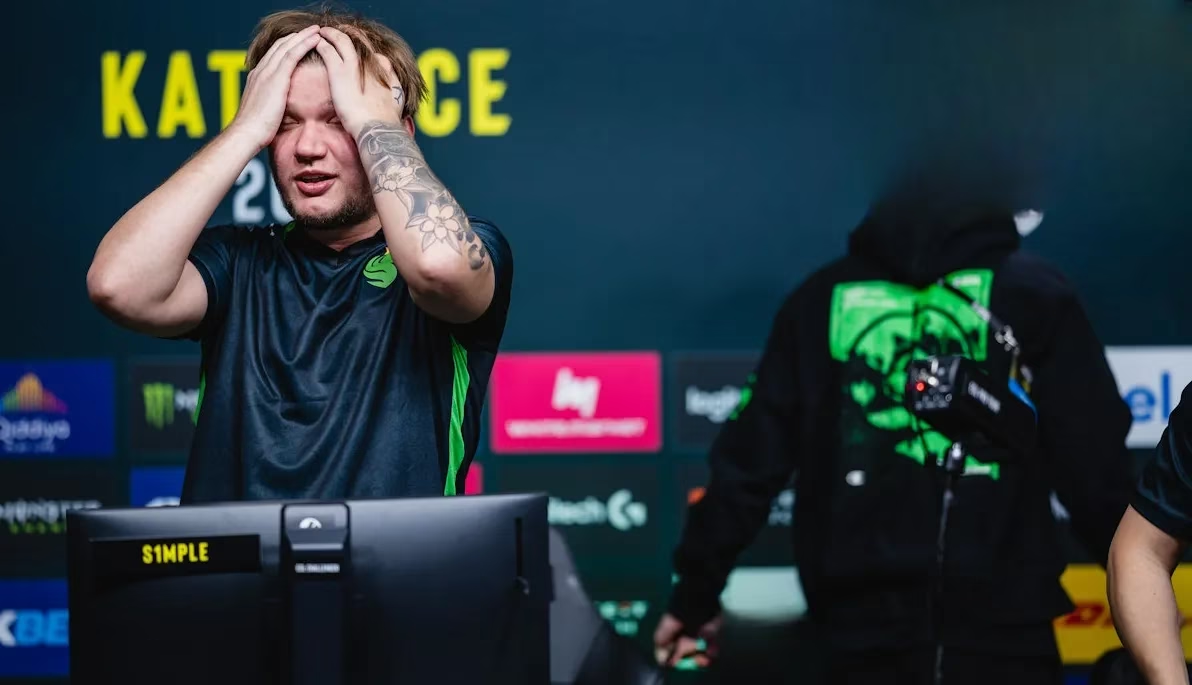
The sporting damage is much bigger than one missed LAN. BC.Game sits around the 16th line of the European VRS, and only the top 17 teams get invitations to the IEM Cologne Major. The deadline for invitation points is April 6, 2026. After their solid top-16 run at IEM Krakow 2026, fans were ready for consolidation. Instead, the team has to scramble for tier-2 tournaments to collect enough points. If not, s1mple might watch the year's biggest Major from the stands, which feels like a football legend being banned from the Champions League over paperwork.
Still, the tournament went on without them. As someone who spends evenings studying map tempo rather than just highlights, I turned to the meta. BC.Game Masters 2026 became a clinic on how map selection decides matches before the first bullet. Anubis stopped being a pretty Egyptian-themed map and became a weapon against favorites. The T-side win rate on Anubis reached 53.7%, which is almost a verdict for passive CT setups. Meanwhile, Ancient looked like a graveyard for attackers, with a 56.8% CT win rate. Those numbers are not trivia; they are modern CS2 economics.
The most painful example came in the quarterfinal between VRS and FaZe Clan. After Nuke, VRS left Anubis open, hoping their mid control would carry them. That was tactical suicide. On Anubis, grenade timing and channel movement beat pure aim. FaZe punished them with a split B-site when VRS could not adapt the economy to fast rotations. I watched it live and felt like a player who forgets to buy utility on a force round. The loss knocked VRS out of the trophy race.
Let me lay out the map problem clearly:
| Map | Key stat | Effect |
|---|---|---|
| Anubis | 53.7% T-side win rate | Aggressive pacing; punishes passive defense |
| Ancient | 56.8% CT-side win rate | Attackers struggle; predictable setups |
| Ancient | 28% ban rate | Too many learned timings, low strategic surprise |
| Ancient | 43.2% attack win rate | Picking it hands your opponent an edge |
Why is Ancient fading? First, predictability. One support on mid can cover two flanks, but top teams have memorized those timings. Second, low unpredictability means information gain collapses during the match. Third, picking a map with a 43.2% attack win rate is voluntary disadvantage. Anubis adds vertical gameplay through temple and water channels, creating high strategy variance. If an analyst does not calculate the probability of Ancient falling through ten ban rotations, their team's Major run is already at risk.
For VRS, the lesson was expensive: key pool assets dropped below 45% in critical moments, ending their BC.Game Masters dream. For BC.Game the organization, the situation is more tragic. They are missing a home event while hanging near the Major cutoff. Their next scheduled stop is IEM Atlanta 2026 in mid-May, but by then the Major slot will likely already be decided. Management needs to announce new performances quickly, otherwise s1mple risks watching the main tournament from the stands.
As a fan, I end with mixed feelings. The competitive integrity rules make sense, but seeing a star removed because of sponsor logic feels hollow. The map math, however, gives me hope that CS2 keeps evolving. In 2026, you study Anubis like a textbook and avoid Ancient like a bad habit. Or you end up watching someone else lift the trophy from home.